Synthesis Essay (Final Draft)
Standard English: A Case Against It
Common in the experience of many immigrants is the process of learning a new language. Here in America, they are taught how to speak and write in Standard English. Yet it is a mistake and even insulting to label a specific form of the language as the standard. To elevate it as the “standard” is to degrade all others. This essay will focus on the origins of Standard English, why there is no correct way to speak and write English, and argue for the acceptance and welcoming of linguistic diversity rather than the suppression of.
It is essential to begin with the origins of Standard English and how it came to be. According to Ellen Holmes Pearson, in the years following America’s independence from Britain, many wanted to establish a culturally distinct identity, differing from their neighbors across the sea. During this time of identity-seeking, the English language underwent several changes. Many Americans each contributed their own edits to the language. One of the major contributors was Noah Webster. Webster, a prominent lexicographer, advocated for the simplification of spelling, and in 1828 published his American Dictionary of The English Language with changes to the spellings and pronunciations of several words. Words like “favour” became “favor”, and “centre” became “center”. Coupled with the ever-advancing printing press, his dictionary paved the way for the standardization of the newly reformed English language (Pearson). Standard English, as it turns out, did not arise naturally. It was developed by select individuals like Webster through deliberate choices, a manufactured “standard”. It is taught that history is written by the victors, and in this case, a few influential figures standardized their own refurbished version of the English language. To put it simply, who’s to say that tomorrow an ordinary person announces the standard to be Pig Latin? Understanding this, it becomes evident that the language of today is, in essence, a product of linguistic engineering.
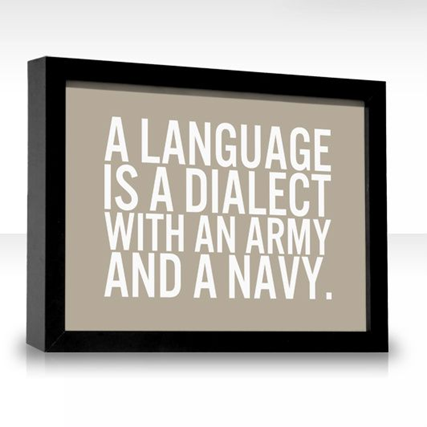
Friedrich Nietzsche once said this: “All things are subject to interpretation. Whichever interpretation prevails at a given time is a function of power and not truth”. Just as Nietzsche puts it, Standard English is simply a function of power. What began as a distinguishing of the American language, quickly became the dominant linguistic norm, championed and powered by the likes of several influential figures. Though practical, it undermined and illegitimized any other variation of English. In William Labov’s Language in the Inner City: Studies in the Black English Vernacular, he cites from a book published by American education researcher Carl Bereiter and American educationalist Siegfried Engelmann. The book, Teaching Disadvantaged Children in the Preschool, documents how Bereiter and Engelmann in the 1960s, together, devised a special kind of preschool that was meant for teaching disadvantaged children, primarily Black children, essential language, mathematical, and reading skills. The “essential language skills” that these children were taught was Standard English. Labov states that the children would not be punished if they used their vernacular speech on the playground, but that they would not be allowed to use it in the schoolroom. Additionally, should they answer a question with their “illogical vernacular form”, they would be reprehended and made to answer with the corrected form (205). By labeling Black English as “illogical” and Standard English as “essential”, Bereiter and Engelmann preached linguistic inferiority. Their teachings reinforced the harmful notion that Standard English was the right way to speak and write English, whilst Black English and any other shape of English was wrong and incorrect. A misleading and dehumanizing claim. A question that should be asked in response is, “Why was Black English labeled as ‘illogical’, and who deemed it so?”. Labov himself says that Black children possess the “same basic vocabulary”, the “same capacity for conceptual learning”, and the “same logic as anyone else who learns to speak and understand English” (201). The consequences that arise from such teachings are dangerous, it not only diminishes the legitimacy and validity in other forms of English, but also serves to erase the cultural history behind each and every one of them. April Baker-Bell, American author of the book Linguistic Justice: Black Language, Literacy, Identity, and Pedagogy, says that schoolings like these deny Black students “the right to use their native language” and teaches them to “reject their language and culture to acquire White Mainstream English” (9). The idea that there is a “right” way to speak English is nothing short of an attempt at maintaining linguistic hierarchies as Bereiter and Engelmann tried to do. In truth, English exists as many. There is no one correct way to use English. All dialects and vernaculars are equally acceptable, each suited to their own contexts and circumstances. Acknowledging this means tolerating the fact that every instance of English has its own logic, history, and authenticity. No single form of English should hold the moniker of “standard”, nor the idea of correctness.
Despite this, there’s an argument most popular among those who would support Standard English. They believe that Standard English is absolutely necessary and vital for “effective communication in situations where clear understanding is crucial” (“Standard English | Revision World”). A mutual form of communication ensures mutual understanding, as they would say. But how much of this is true? The answer: not very much. Take for example, a baby. If they were to say “milk”, they’d most likely be wanting to be fed. Or even better, raising their arms and flapping them, perhaps signaling that they’d want a lift. In both cases, Standard English was not used, and yet, the messages themselves were perfectly comprehensible. So what does this mean? Well, it means that Standard English, in fact, is not absolutely necessary for communication. If it’s possible to understand a single word from a baby, or even gestures, then what makes it impossible for Black English or any other English for that matter, to be understood in that same regard?
Standard English has always been about the suppression of linguistic diversity. Its birth is attributed to the likes of Webster, whose dictionary remains an authoritative source in the linguistic convention of the modern day. Its existence is perpetuated through the institutional conditionings in the classroom, as evidenced by Bereiter and Engelmann’s preschool studies. To continue echoing the conviction of “correctness” means to allow the deprecating nature of Standard English to sustain. Only by doing away with this misleading perception, can the embracing of the rich linguistic variations begin. Language is meant for unity, the bridge between people from all walks of life. When it is celebrated in all forms, when it is welcomed and accepted, the linguistic hierarchies that have been long upheld will finally be dismantled and shattered. To create an inclusive environment and begin a reclamation of identities and voices that have been long suppressed and erased by modern linguistic standards, that is the future that should be strived for.

Works Cited
Baker-Bell, April. “Dismantling anti-black linguistic racism in English language arts classrooms: Toward
an anti-racist Black Language Pedagogy.” Theory Into
Practice, vol. 59, no. 1, 14 Nov. 2019, pp. 8–21, https://doi.org/10.1080/00405841.2019.1665415.
Labov, William. Language in the Inner City: Studies in the Black English Vernacular. Univ. of
Pennsylvania Press, 2010.
Pearson, Ellen Holmes. “The Standardization of American English.” The Standardization of American
English | TeachingHistory.Org, The Roy Rosenzweig Center for History and New Media,
teachinghistory.org/history-content/ask-a-historian/25489. Accessed 26 Oct. 2025.
“Standard English.” Revision World, revisionworld.com/gcse-revision/english-language-gcse/spoken-
language/standard-english. Accessed 19 Nov. 2025.

This entry is licensed under a Creative Commons Attribution-NonCommercial-ShareAlike 4.0 International license.

