Final Reflection Essay
Throughout this fall semester, I have learned many things in relation to language and identity, all the while honing my skills as a writer and becoming a more empathetic person. I’ve discovered how compliments validate others , how being “normal” has a lot to do with conforming to societal expectations, how other forms of English besides Standard English are not “broken”, and how Standard English can be oppressive.
In my Language & Literacy Narrative, I learned how valuable compliments are when received. In my LLN, I wrote about how I felt after receiving a compliment. I said, “In that moment, I was happy, I was proud, and for a second, I actually liked Ms. O’Keefe.” Hearing her compliment made me feel seen, feel validated. That feeling after receiving a compliment, I want others to feel the same way as I did, and that’s what I learned. Leaving a simple compliment can make someone’s day, you never know what the other person might’ve gone through or done to get to where they are, and simply acknowledging it can leave them feeling confident about themselves, seen or acknowledged, validated.

While watching Safwat Saleem’s ted talk, I learned how being “normal” is tied to societal expectations. Saleem was telling about how in the past, he had narrated videos, and oftentimes, he would receive hateful comments about his accent. Saleem said that these comments eventually made him stop narrating, and it wasn’t until he thought about what constituted a “normal” voice. He describes “normal” as a “construction of what we’ve been exposed to, and how visible it is around us.” Since his viewers had never heard of a narrator with his accent before, they thought it wasn’t “normal.” Listening to his story, I realized that he was right. The normal is a collection of experiences, and conceptually, when experiencing something outside of what you’ve seen/understood, you can’t help but label it as abnormal, as different, as not normal. In my discussion post, I wrote in my own words that “being normal has a lot to do with societal expectations.” If society is constantly exposed to only narrators that are for example British, then of course Saleem’s Pakistani accent would be labeled as “not normal”. What we accept as “normal” only reflects our limited experiences.

Near the beginning of the semester, I read Amy Tan’s Mother Tongue. Just like Tan, I am also a Chinese-American. From her essay, I’ve learned that other forms of English are not inherently wrong, and most importantly, not broken. Tan writes that she used to believe that her mother’s English was “limited”, “fractured”, and “broken”. But she says that whenever she catched herself believing that, she felt that it was wrong. It sounded as if her mother’s English was “damaged and needed to be fixed.” The thing is, I used to think like her about my mother’s own English. I used to think to myself, “Why can’t she learn proper grammar?” An example would be when my mom says, “Why you do that?” But after reading Mother Tongue, I’ve come to realize that just as Tan mother’s English isn’t broken, neither is my mother’s. Tan concluded beautifully with how she wrote a book specifically meant to be read by her mother, and her mother told her that it was so easy to read. That’s what I’ve learned, that no matter if your English is “limited” or “broken”, at the end of the day, it’s still English. If you can read it and understand it, then is it really broken? I understand my mother just fine, and though her English to others might seem incorrect, to me her English is perfect.
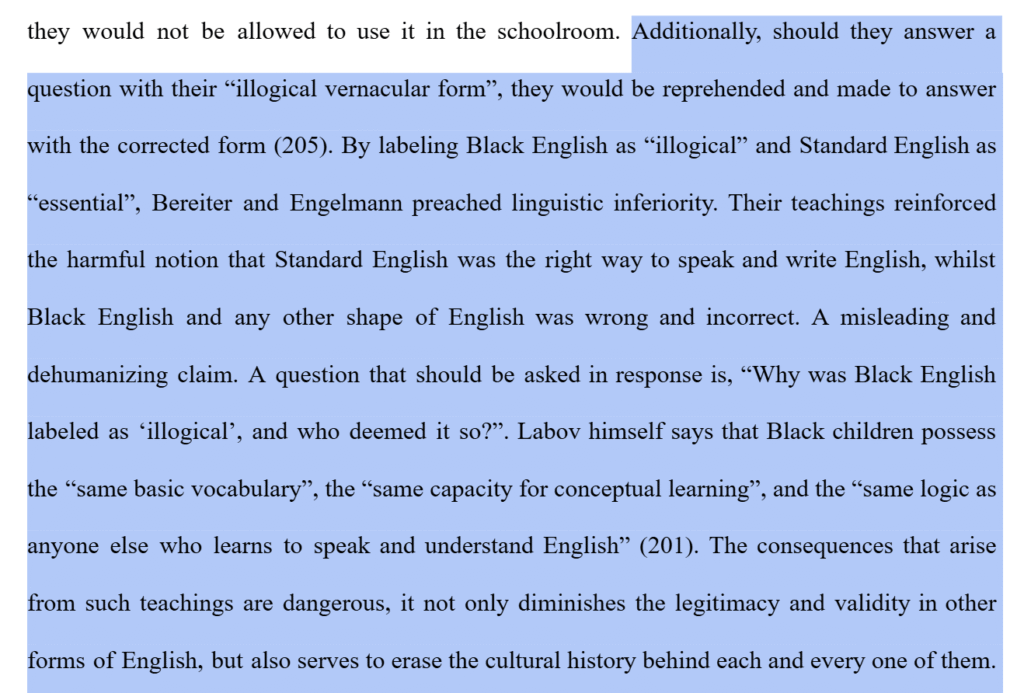
Finally, I’ve learned that Standard English is by nature, oppressive. Through my Synthesis Essay, I explored the origins of Standard English and the impact it has on other forms of English, as well as the impact on minorities in America, specifically Black communities. In my Synthesis Essay, I focused on Black children being taught Standard English. I wrote that should the children “answer a question with their ‘illogical vernacular form’, they would be reprehended and made to answer with the corrected form.” These children were taught that Standard English was the “correct” and “logical” form of English, and I also wrote that the two American researchers “preached linguistic inferiority” as a result of such teachings. This is just one example of Standard English being oppressive. Another example talked about in my Synthesis Essay was that by imposing the strict rule of only using Standard English, culture and identity is invalidated and practically erased. When other forms of English are denigrated and seen as “incorrect”, we reinforce the idea of a language hierarchy. In other words, we forcibly oppress a language/languages if they’re not Standard English.
Ultimately, these lessons have taught me that language is not just about communication, but about identity as well. From learning how to use OneSearch for my research paper, to learning about the connection between language and identity, I have found each lesson meaningful and full of learning opportunities.

This entry is licensed under a Creative Commons Attribution-NonCommercial-ShareAlike 4.0 International license.

